The Three Distinct Sales Tax Systems in Canada
Unlike the United States where sales tax is strictly administered at the state and municipal levels, or India where a unified GST Council governs all rates, Canada uses a three-tier hybrid structure:
- 1. GST-Only Provinces & Territories (5% Total): Alberta, Northwest Territories, Nunavut, and Yukon levy no provincial sales tax. Only the 5% federal Goods and Services Tax (GST) is charged on taxable supplies.
- 2. Dual-Tax Provinces (5% GST + Provincial PST/QST): British Columbia (7% PST), Saskatchewan (6% PST), Manitoba (7% PST/RST), and Quebec (9.975% QST) maintain separate provincial sales tax systems alongside the federal GST. In these provinces, businesses must register separately with the provincial revenue ministry and file two independent returns.
- 3. Harmonized Sales Tax (HST) Provinces (13% to 15% Total): Ontario (13%), Nova Scotia (14% effective April 1, 2025), New Brunswick (15%), Newfoundland and Labrador (15%), and Prince Edward Island (15%) have merged their provincial taxes with the federal GST under a single administrative umbrella managed directly by the Canada Revenue Agency (CRA).
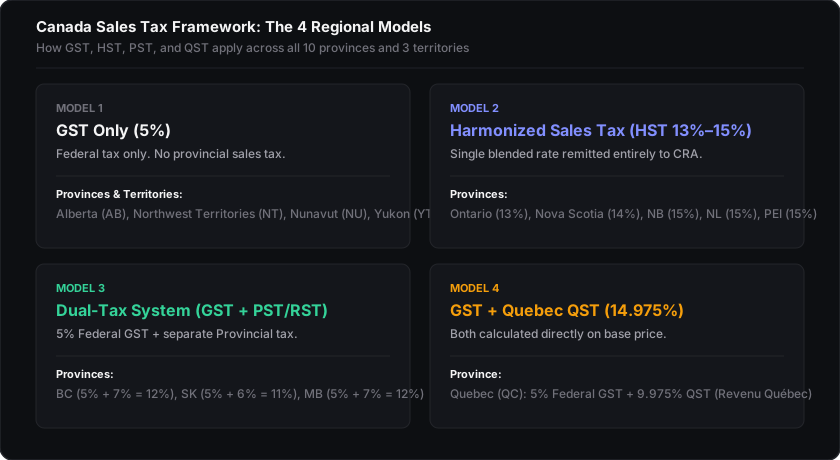
2026 Provincial Sales Tax Rates: Complete 13-Jurisdiction Breakdown
Below is the official statutory sales tax rate breakdown across all 13 Canadian provinces and territories. You can test custom calculations on the TrueGST Canada Calculator.
| Province / Territory | System Type | Federal GST | Provincial Tax | Total Tax Rate |
|---|---|---|---|---|
| Alberta | GST Only | 5% | 0% | 5% |
| British Columbia | Dual Tax (GST + PST) | 5% | 7% PST | 12% |
| Manitoba | Dual Tax (GST + RST) | 5% | 7% RST | 12% |
| New Brunswick | Harmonized (HST) | 5% | 10% | 15% HST |
| Newfoundland & Labrador | Harmonized (HST) | 5% | 10% | 15% HST |
| Northwest Territories | GST Only | 5% | 0% | 5% |
| Nova Scotia | Harmonized (HST) | 5% | 9% | 14% HST* |
| Nunavut | GST Only | 5% | 0% | 5% |
| Ontario | Harmonized (HST) | 5% | 8% | 13% HST |
| Prince Edward Island | Harmonized (HST) | 5% | 10% | 15% HST |
| Quebec | Dual Tax (GST + QST) | 5% | 9.975% QST | 14.975% |
| Saskatchewan | Dual Tax (GST + PST) | 5% | 6% PST | 11% |
| Yukon | GST Only | 5% | 0% | 5% |
Provincial Variations: Key Nuances You Must Know
1. Nova Scotia's 14% HST Rate Reduction
Effective April 1, 2025, Nova Scotia reduced its provincial HST component from 10% to 9%, lowering the combined HST rate from 15% to 14%. Any contracts, invoices, or services rendered in Nova Scotia after April 1, 2025, must be calculated at 14% rather than 15%.
2. Quebec's QST: The Myth of the "Tax-on-Tax"
Prior to 2013, Quebec calculated QST on the total amount including federal GST. However, effective January 1, 2013, QST is calculated strictly on the base pre-tax amount at 9.975%. On an invoice with a $1,000 base:
- Federal GST (5%): $1,000 × 0.05 = $50.00
- Quebec QST (9.975%): $1,000 × 0.09975 = $99.75
- Total Combined Sales Tax: $149.75 (Total Invoice: $1,149.75)
3. BC, Saskatchewan, and Manitoba (Dual Remittance)
In non-harmonized provinces, businesses must file two completely distinct returns: one to the CRA for federal GST and another to the provincial finance ministry for PST. Input Tax Credits (ITCs) are generally only available for the 5% GST component, whereas provincial PST paid by businesses is treated as an operating expense rather than a refundable credit.
CRA Registration: The $30,000 Small Supplier Rule
Under the Canadian Excise Tax Act, small businesses and freelancers are not legally mandated to register for a GST/HST account until they exceed the $30,000 gross revenue threshold across 4 consecutive calendar quarters.
- Single Quarter Spike: If your worldwide gross taxable sales exceed $30,000 in a single calendar quarter, you immediately lose small supplier status on the supply that put you over the threshold. You must collect tax on that transaction and register within 29 days.
- Four Consecutive Quarters: If your total revenue exceeds $30,000 across four consecutive calendar quarters combined, you cease to be a small supplier at the end of the month following that quarter.
- Voluntary Registration: Even if you earn less than $30,000, registering voluntarily allows you to claim Input Tax Credits (ITCs) to recover all GST/HST paid on computers, software subscriptions, office rent, and tools.
- Important Exception: Rideshare (Uber/Lyft) and commercial limousine drivers must register immediately from their very first dollar of income.
Zero-Rated Supplies vs. Tax-Exempt Supplies
Many entrepreneurs conflate zero-rated goods with exempt goods because the consumer pays 0% tax at checkout in both instances. However, for a registered business, the accounting distinction directly impacts your tax recovery:
Zero-Rated Supplies (0% Tax • ITCs Allowed)
Tax is charged at 0%. The vendor charges no tax to customers, but can claim full Input Tax Credits (ITCs) to recover sales taxes paid on business inputs. Common examples include basic groceries, prescription drugs, medical devices, and exports of goods or services to foreign clients (such as US clients).
Exempt Supplies (No Tax • No ITCs Allowed)
No tax is charged to the purchaser, and the business cannot claim ITCs to recover GST/HST paid on operating costs used to deliver these services. Common examples include long-term residential rent (≥ 30 days), healthcare services performed by licensed practitioners, and standard educational courses.
Place of Supply: Which Provincial Rate Do You Charge?
Under CRA regulations, the tax rate charged on an invoice is determined by where the supply is deemed to be delivered (the consumer's billing destination), not where your business office is physically situated:
- Tangible Goods: Charge the tax rate of the province where the purchaser takes delivery or where the goods are shipped. If an Alberta business (5%) ships goods to an Ontario customer, the invoice must charge 13% Ontario HST.
- Services & Digital Products: Charge the tax rate of the province where the client has their address or primary establishment. If a freelancer in Toronto (13%) designs a website for an Alberta client, they charge only 5% GST.
- International Clients: Services supplied to non-residents outside of Canada are treated as zero-rated (0% GST/HST).
E-Commerce Invoicing: Cross-Province Shipping & Dropshipping
With the expansion of Shopify, WooCommerce, and Amazon FBA across Canada, businesses must configure automated checkout taxes according to the destination principle:
- Ontario Store Selling to BC Buyer: The vendor must charge 5% GST on the checkout order. If the vendor does more than $10,000 in annual BC sales, they may also be required to register for and collect 7% BC PST under BC's marketplace seller rules.
- Vancouver Store Selling to Halifax Buyer: Goods shipped to Nova Scotia are subject to Nova Scotia's 14% HST. The shipping fee itself is also taxed at 14% HST as an ancillary service.
- Dropshipping Direct to Customer: When an intermediary arranges for a third-party manufacturer to ship goods directly to a retail consumer, the Place of Supply is determined by where the retail customer takes physical possession of the product.
The Canadian Digital Services Regime for Non-Resident Businesses
In response to the growth of global technology platforms, the federal government enacted simplified GST/HST rules for non-resident vendors. Foreign corporations with no physical presence in Canada (such as streaming platforms, SaaS providers, and app stores) must register for and collect GST/HST if:
- They supply digital products, music, software licenses, or streaming subscriptions to Canadian non-business consumers (B2C).
- Their annual sales to Canadian consumers exceed the $30,000 CAD threshold.
Under this simplified framework, foreign businesses collect federal GST and provincial HST based on the subscriber's billing address, but cannot claim Input Tax Credits on Canadian business expenses.
Frequently Asked Questions
What is the difference between GST, PST, QST, and HST in Canada?
GST (Goods and Services Tax) is the 5% federal sales tax applied nationwide. PST (Provincial Sales Tax) or RST is a separate provincial tax charged by British Columbia (7%), Saskatchewan (6%), and Manitoba (7%). QST (Quebec Sales Tax) is Quebec's 9.975% provincial tax administered by Revenu Québec. HST (Harmonized Sales Tax) combines the federal 5% GST with provincial tax into a single blended rate (13% to 15%) administered entirely by the Canada Revenue Agency (CRA).
What are the Harmonized Sales Tax (HST) provinces in Canada?
Five Canadian provinces participate in the Harmonized Sales Tax framework: Ontario (13% HST), Nova Scotia (14% HST, effective April 1, 2025), New Brunswick (15% HST), Newfoundland and Labrador (15% HST), and Prince Edward Island (15% HST). In these provinces, businesses collect a single combined tax and remit it directly to the CRA.
Does Alberta have a provincial sales tax?
No. Alberta is the only Canadian province with no provincial sales tax (0% PST). Only the 5% federal GST applies to taxable purchases and services in Alberta. Canada's three territories (Yukon, Northwest Territories, and Nunavut) also do not levy territorial sales tax, charging only the 5% GST.
What is the current Quebec sales tax (QST) rate in 2026?
The Quebec Sales Tax (QST) rate is 9.975%. Combined with the federal 5% GST, the total sales tax in Quebec is 14.975%. Since January 1, 2013, QST is calculated directly on the pre-tax selling price (base price), eliminating the historic 'tax-on-tax' calculation method.
At what revenue threshold do Canadian businesses need to register for GST/HST?
Under the CRA Small Supplier Rule, businesses and sole proprietors must register for a GST/HST account once their worldwide gross taxable revenues exceed $30,000 within a single calendar quarter or across four consecutive calendar quarters. Businesses earning $30,000 or less qualify as small suppliers and are exempt from mandatory registration, though voluntary registration is permitted to claim Input Tax Credits (ITCs).
What is the difference between zero-rated and tax-exempt goods in Canada?
Zero-rated supplies (such as basic groceries, prescription medications, medical devices, and exported goods) are taxed at 0% GST/HST, and businesses can claim Input Tax Credits (ITCs) to recover all sales tax paid on operating expenses. Tax-exempt supplies (such as residential rent, dental/medical healthcare services, and standard educational courses) have no tax charged, but businesses cannot claim ITCs on associated operational costs.