The Fundamental Rule: Why You Can Never Just "Subtract 13%"
The single most frequent calculation error in Canadian small business bookkeeping is attempting to reverse calculate tax by subtracting the tax percentage from a gross total.
Consider an Ontario invoice with a pre-tax price of $100.00. With 13% HST added, the total amount payable is $113.00.
The Flawed Approach (Direct Percentage Subtraction):
$113.00 − 13% = $113.00 − $14.69 = $98.31 (Base short by $1.69!)
The Correct Mathematical Approach (Division by 1 + Rate):
$113.00 ÷ 1.13 = $100.00 (Exact Base Value)
$113.00 − $100.00 = $13.00 (Exact 13% HST)
Because statutory sales taxes are assessed on the pre-tax base amount, removing them from a gross total always requires division rather than direct subtraction. When you calculate tax forward, the rate operates on the base. When you work backward from the gross amount, you are dividing by a multiplier that represents 100% of the cost plus the applicable sales tax percentage.
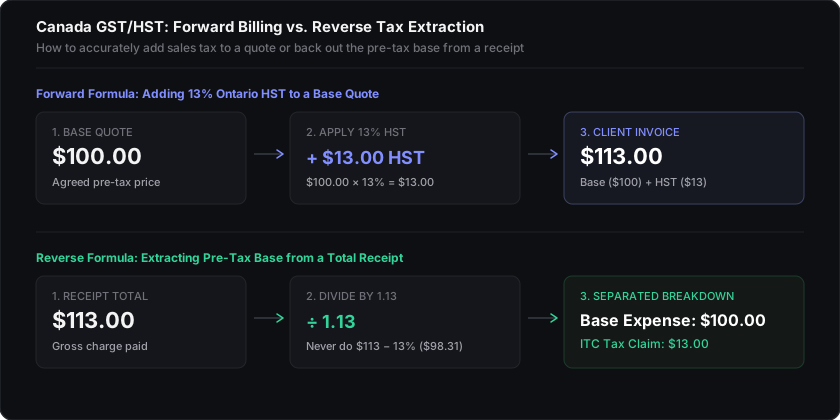
The Two Master Formulas
1. The Forward Formula (Adding GST/HST to Base Price)
When preparing client proposals or commercial invoices, compute tax from your base quote:
2. The Reverse Formula (Extracting Base from Gross Total)
When reconciling receipts, credit card statements, or retail totals:
Provincial Decimal Shortcuts Reference Table
To perform calculations quickly on any standard calculator, divide the gross total by the Base Divisor, or multiply directly by the Tax Factor:
| Province / Territory | Rate & Type | Base Divisor | Tax Multiplier |
|---|---|---|---|
| AB, NT, NU, YT | 5% GST | 1.05 | × 0.047619 |
| Saskatchewan | 11% (5% GST + 6% PST) | 1.11 | × 0.099099 |
| BC, Manitoba | 12% (5% GST + 7% PST/RST) | 1.12 | × 0.107143 |
| Ontario | 13% HST | 1.13 | × 0.115044 |
| Nova Scotia | 14% HST (Reduced from 15%) | 1.14 | × 0.122807 |
| NB, NL, PEI | 15% HST | 1.15 | × 0.130435 |
| Quebec | 14.975% (5% GST + 9.975% QST) | 1.14975 | × 0.130246 |
Reverse Calculations in Dual-Tax Provinces (BC & Quebec)
In provinces with separate sales taxes, both GST and provincial tax are levied on the same pre-tax base. This means you first extract the common base, then multiply by each individual rate:
British Columbia ($1,000 Total Bill)
Rate: 5% GST + 7% PST = 12% combined:
- Base Price = $1,000 ÷ 1.12 = $892.86
- Federal GST (5%) = $892.86 × 0.05 = $44.64
- BC PST (7%) = $892.86 × 0.07 = $62.50
Québec ($1,000 Total Bill)
Rate: 5% GST + 9.975% QST = 14.975% combined:
- Base Price = $1,000 ÷ 1.14975 = $869.75
- Federal GST (5%) = $869.75 × 0.05 = $43.49
- Quebec QST (9.975%) = $869.75 × 0.09975 = $86.76
How to Audit Mixed Receipts: Zero-Rated vs. Taxable Purchases
A frequent pitfall for Canadian freelancers, contractors, and business owners occurs when reviewing big-box or supermarket receipts (such as Costco, Walmart, or Canadian Tire). These receipts frequently contain a combination of zero-rated basic groceries (taxed at 0%) and taxable supplies (such as printer paper, office snacks, cleaning supplies, or electronics).
If you simply take the bottom-line total of the entire receipt and divide by 1.13 or 1.15, you will severely miscalculate your deductible expenses and claim excessive Input Tax Credits—which CRA automated audits quickly flag.
- Basic Groceries (Apples, Bread, Milk - 0% Tax): $45.00
- Office Paper & Pens (Taxable at 13% Ontario HST): $50.00
- HST Paid on Taxable Portion ($50 × 0.13): $6.50
- Total Receipt Amount: $101.50
The Wrong Method: Dividing $101.50 by 1.13 yields $89.82 base and $11.68 tax. That claims $5.18 of imaginary tax that was never paid, triggering penalty assessments. Always check the receipt subtotal marked with 'H' or 'T' before applying reverse math.
The CRA Quick Method: An Alternative to Tracking Individual ITCs
Small businesses with annual taxable worldwide supplies (including zero-rated supplies) of $400,000 CAD or less may elect to use the CRA Quick Method of Accounting (filed via Form GST107).
Under the Quick Method, you continue charging the full statutory GST/HST rate to your customers, but instead of tracking every single receipt to calculate ITCs, you remit a reduced flat percentage of your gross sales directly to the CRA. You keep the difference as additional business revenue.
| Business Type | 5% GST Province | 13% Ontario HST | 15% HST Province |
|---|---|---|---|
| Service Businesses & Consultants | 3.6% | 8.8% | 10.4% |
| Retailers & Wholesalers | 1.8% | 4.4% | 5.2% |
In addition, Quick Method users receive a 1% credit on the first $30,000 of gross eligible sales in each fiscal year, saving up to an extra $300 in taxes annually.
CRA Audit Checklist: What Invoices Must Show Before You Claim an ITC
Under the Excise Tax Act (Information Regulations), you cannot claim an Input Tax Credit simply because you have a credit card statement charge. The CRA requires physical or digital supporting invoices matching strict monetary thresholds:
- • Supplier's business name
- • Date of transaction
- • Total amount paid
- • All items from Tier 1
- • 9-digit CRA Business Number (BN)
- • Clear tax breakdown or rate
- • All items from Tiers 1 & 2
- • Buyer's legal or trade name
- • Detailed description of goods
- • Payment terms & invoice #
If a vendor fails to print their valid CRA Business Number on invoices exceeding $30, the CRA can disallow your entire ITC claim upon audit, forcing you to pay back the tax with compounding interest.
Excel & Google Sheets Formulas for Canadian Invoicing
Always wrap tax equations in the ROUND(..., 2) function to ensure currency compliance. Assume cell A2 holds the monetary amount:
Reverse Formulas (From Total in A2)
// Extract Pre-Tax Base (Ontario 13% HST):
=ROUND(A2 / 1.13, 2)
// Extract Embedded HST (Ontario 13%):
=ROUND(A2 * (13 / 113), 2)
// Extract 5% Federal GST from Total:
=ROUND(A2 * (5 / 105), 2)
Forward Formulas (From Base in A2)
// Add 13% Ontario HST to Base:
=ROUND(A2 * 1.13, 2)
// Add 14% Nova Scotia HST to Base:
=ROUND(A2 * 1.14, 2)
// Add 5% GST Only (Alberta/Territories):
=ROUND(A2 * 1.05, 2)
Calculating CRA GST/HST Net Remittance (Form GST34)
When filing your return with the CRA, your actual remittance or refund is determined by this offset equation:
- Line 101: Sales and other revenue (strictly the net base taxable revenue; do not include taxes).
- Line 105: Total GST/HST collected or that became collectible from clients.
- Line 108: Total Input Tax Credits (ITCs) — all GST/HST paid on legitimate commercial business purchases.
- Positive Line 109: If Line 105 > Line 108, you remit this net balance to the Receiver General for Canada.
- Negative Line 109: If Line 108 > Line 105, the CRA issues a direct deposit refund to your business bank account.
Frequently Asked Questions
How do I calculate GST from a total amount in Canada?
To calculate the 5% GST from a total inclusive amount in Canada, divide the gross total by 1.05 to obtain the pre-tax base price, then subtract the base price from the gross total. Alternatively, multiply the total amount directly by 5/105 (approximately 0.047619). For example, on an inclusive receipt of $105.00: Base Price = $105 / 1.05 = $100.00, and GST = $105 - $100 = $5.00.
What is the formula to extract HST from a gross price?
The statutory formula to extract HST depends on the province's rate. For Ontario (13% HST): Base Price = Total / 1.13, and HST = Total - Base Price (or Total × 13/113). For Nova Scotia (14% HST): Base Price = Total / 1.14, and HST = Total × 14/114. For New Brunswick, Newfoundland, and PEI (15% HST): Base Price = Total / 1.15, and HST = Total × 15/115.
How do I add 5% GST to a pre-tax price?
To add 5% GST to a pre-tax base amount, multiply the base price by 0.05 to determine the tax, and add that to the base price. Alternatively, multiply the base price directly by 1.05. For example, on a $500 pre-tax service invoice in Alberta: GST = $500 × 0.05 = $25.00, and Total = $500 × 1.05 = $525.00.
How do you calculate GST and PST from a total receipt in British Columbia?
In British Columbia, the combined rate is 12% (5% GST + 7% PST). Because both taxes are calculated on the same pre-tax base: Pre-Tax Base = Total / 1.12. Once the base is known: GST (5%) = Base × 0.05, and PST (7%) = Base × 0.07. For an inclusive bill of $112.00: Base = $112 / 1.12 = $100.00; GST = $5.00; PST = $7.00.
What is the Excel formula to reverse calculate HST in Canada?
In Microsoft Excel or Google Sheets, if cell A2 contains the gross inclusive total and the tax rate is 13% (Ontario): Base Price: =ROUND(A2 / 1.13, 2). Tax Amount: =ROUND(A2 - (A2 / 1.13), 2) or =ROUND(A2 * (13 / 113), 2). For a variable rate in cell B2 (e.g., 0.13 or 13): Pre-Tax Base: =ROUND(A2 / (1 + B2/100), 2).
How do I separate GST from gross sales for CRA tax filing?
To report your sales accurately on CRA Form GST34 (Line 101 and Line 105), separate your gross takings by tax tier. For a 5% GST region, pre-tax sales (Line 101) = Total Gross Sales / 1.05, and GST collected (Line 105) = Total Gross Sales - Line 101. Do not report total gross revenue including sales tax on Line 101.