Why India Splits GST into Three Tax Streams
If you have ever looked at a tax invoice and wondered why you are paying two separate 9% taxes instead of a single 18% charge, it comes down to revenue sharing between New Delhi and state capitals. Before July 2017, businesses dealt with an exhausting maze of Central Excise, State VAT, Service Tax, and Octroi checkpoints at state borders—often paying tax on top of tax.
India solved this with a Dual GST model. Instead of one government taking all revenue and redistributing it later, every transaction is assigned to one of three tax streams right at the moment of billing:
- CGST (Central Goods and Services Tax): Governed by the CGST Act 2017, collected directly by the Central Board of Indirect Taxes and Customs (CBIC) on intra-state supplies.
- SGST / UTGST (State / Union Territory GST): Governed by respective state legislative acts, retained entirely by the state or union territory where consumption occurs.
- IGST (Integrated Goods and Services Tax): Governed by the IGST Act 2017, levied on all inter-state supplies and cross-border imports. The Centre collects IGST and apportions the destination state's share according to constitutional formulas.
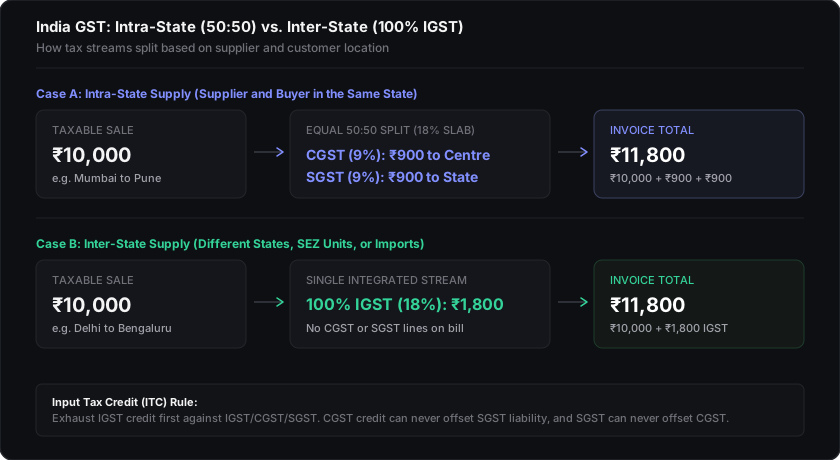
Intra-State (50:50 Split) vs. Inter-State (100% IGST)
Calculating whether you charge CGST + SGST or IGST hinges entirely upon two statutory concepts: Location of the Supplier and Place of Supply (PoS). You can verify your exact figures with the TrueGST India Calculator.
Intra-State Supply (Same State)
When the location of the supplier matches the place of supply, tax is split exactly 50% as CGST and 50% as SGST (or UTGST). An 18% tax slab divides into 9% CGST and 9% SGST. For example, a merchant in Pune selling to a buyer in Nagpur applies 9% CGST + 9% SGST. On a ₹10,000 order, that equals ₹900 CGST and ₹900 SGST.
Inter-State Supply (Different States)
When the location of the supplier and the place of supply are in different states, tax is levied as a single consolidated 100% IGST stream. No CGST or SGST is shown on the commercial invoice. For example, a merchant in Delhi shipping to a buyer in Jaipur charges 18% Integrated GST (IGST).
Special Transactions Treated as Inter-State by Law
- Supplies to or by Special Economic Zone (SEZ) Units / Developers: Even if an SEZ unit is physically located across the street in the same city, supplies to or from it are deemed inter-state under Section 7(5)(b) of the IGST Act.
- Import of Goods or Services into India: Treated as inter-state supplies subject to IGST (plus Basic Customs Duty for physical goods).
- Export of Goods or Services: Treated as zero-rated inter-state supplies (filed with LUT under Section 16 of the IGST Act).
Current GST Slabs in India (0%, 5%, 12%, 18%, 28%)
The GST Council classifies all goods and services under standardized HSN (Harmonized System of Nomenclature) and SAC (Services Accounting Code) classifications across five primary statutory slabs. In addition, certain demerit and luxury goods incur a GST Compensation Cess:
| Rate Slab | Intra-State Split | Inter-State (IGST) | Key Classifications |
|---|---|---|---|
| 0% (Nil) | 0% CGST + 0% SGST | 0% IGST | Fresh unbranded milk, vegetables, eggs, healthcare, school education |
| 5% Slab | 2.5% CGST + 2.5% SGST | 5% IGST | Pre-packaged curd, life-saving medicines, tea, coffee, economy rail travel |
| 12% Slab | 6.0% CGST + 6.0% SGST | 12% IGST | Business computers, dairy equipment, apparel above ₹1,000, hotels ₹1,000–₹7,500 |
| 18% Slab | 9.0% CGST + 9.0% SGST | 18% IGST | IT & SaaS software, consulting, consumer electronics, restaurants (with AC) |
| 28% Slab | 14.0% CGST + 14.0% SGST | 28% IGST | Automobiles, premium motorcycles, air conditioners, aerated drinks (+ Cess up to 40%) |
The 18% Standard Slab Breakdown
Because over 60% of all commercial B2B invoices and services attract the 18% tax slab, understanding the exact intra-state split (9% CGST + 9% SGST) versus inter-state (18% IGST) across common transaction amounts helps avoid rounding errors:
| Base Amount | CGST (9%) | SGST (9%) | Total Intra-State Tax | Gross Invoice | 18% IGST |
|---|---|---|---|---|---|
| ₹1,000.00 | ₹90.00 | ₹90.00 | ₹180.00 | ₹1,180.00 | ₹180.00 IGST |
| ₹5,000.00 | ₹450.00 | ₹450.00 | ₹900.00 | ₹5,900.00 | ₹900.00 IGST |
| ₹10,000.00 | ₹900.00 | ₹900.00 | ₹1,800.00 | ₹11,800.00 | ₹1,800.00 IGST |
| ₹50,000.00 | ₹4,500.00 | ₹4,500.00 | ₹9,000.00 | ₹59,000.00 | ₹9,000.00 IGST |
| ₹1,00,000.00 | ₹9,000.00 | ₹9,000.00 | ₹18,000.00 | ₹1,18,000.00 | ₹18,000.00 IGST |
Input Tax Credit (ITC): Rules & Utilization Order
Input Tax Credit (ITC) prevents tax cascading. When your business purchases inventory, software subscriptions, or commercial assets, the GST you pay to vendors is credited to your Electronic Credit Ledger, reducing the net tax you remit to the government.
The 4 Mandatory Conditions to Claim ITC (Section 16(2))
- Possession of a Tax Invoice or Debit Note: You must hold a valid GST tax invoice issued by a registered supplier under Rule 46.
- Actual Receipt of Goods or Services: You must have physically received the goods or the service must have been completely rendered.
- Tax Paid to the Government: The vendor must have reported the invoice in their GSTR-1, reflecting accurately in your GSTR-2B statement, and discharged their tax in GSTR-3B.
- Valid Return Filed: You must furnish your monthly or quarterly return under Section 39 (GSTR-3B).
Statutory Order of ITC Utilization (Sections 49A & 49B)
The government mandates a strict sequence in which tax credits must be set off against output tax liabilities:
- Step 1 (Exhaust IGST Credit First): IGST input credit must first offset IGST output liability. Any remaining IGST credit can be utilized against CGST and SGST output liabilities in any proportion or order.
- Step 2 (Utilize CGST Credit): CGST input credit can only offset CGST output liability, and subsequently IGST liability. CGST credit can never offset SGST liability.
- Step 3 (Utilize SGST Credit): SGST input credit can only offset SGST output liability, and subsequently IGST liability. SGST credit can never offset CGST liability.
Calculating Net Cash Liability (Form GSTR-3B)
GST is paid strictly on the value addition created by your business:
Example: A digital agency in Delhi delivers ₹10,00,000 worth of consulting services at 18% GST (Output GST collected = ₹1,80,000). During the same month, the agency paid ₹60,000 in GST for cloud hosting, office laptops, and telecom. Net cash payable into the Electronic Cash Ledger is ₹1,20,000 (₹1,80,000 − ₹60,000).
Compliance Note: Rule 86B (1% Cash Payment)
If a registered taxpayer's monthly taxable supply value (excluding exempt and zero-rated supplies) exceeds ₹50 Lakhs, Rule 86B prohibits using ITC to discharge more than 99% of output tax liability. The business must pay at least 1% of the tax liability in cash through the Electronic Cash Ledger, regardless of how much accumulated ITC balance is available.
Rule 46 Invoice Checklist: Ensuring Your Invoices Pass GST Audits
Under Rule 46 of the CGST Rules 2017, every valid tax invoice must contain:
- Name, address, and GSTIN of the supplier
- Consecutive serial number (≤ 16 characters)
- Date of issue
- Name, address, and GSTIN of the recipient
- HSN code for goods or SAC code for services
- Description of goods or services rendered
- Total taxable value (net of discounts)
- Rate of tax and split breakdown (CGST, SGST, IGST)
- Place of Supply along with State Name and Code
- Signature or digital signature of authorized person
Frequently Asked Questions
How is the CGST and SGST split calculated for intra-state sales?
For any intra-state transaction (supplier and recipient located in the same state), total GST is divided equally in a 50:50 ratio. For an 18% GST slab, exactly 9% is levied as Central Goods and Services Tax (CGST) and 9% is levied as State Goods and Services Tax (SGST) or Union Territory GST (UTGST). For example, on a ₹10,000 taxable sale, CGST is ₹900 and SGST is ₹900.
When does IGST apply instead of CGST and SGST?
Integrated GST (IGST) applies under Section 5 of the IGST Act whenever a transaction is classified as an inter-state supply. This occurs when the supplier's location and the place of supply are in different states or union territories, when supplying goods or services to/from a Special Economic Zone (SEZ), or on international imports into India.
What is the statutory order of utilization for Input Tax Credit (ITC)?
Under Sections 49, 49A, and 49B of the CGST Act, IGST credit must be exhausted completely first against IGST output liability, and any remaining balance can be used against CGST and SGST in any proportion. CGST credit can only offset CGST and IGST liability (never SGST). SGST credit can only offset SGST and IGST liability (never CGST).
What are the current GST tax slabs in India (0%, 5%, 18%, 28%)?
India's GST structure features five primary rates: 0% (Nil/Exempt for basic food, health, education), 5% (merit goods, life-saving medicines, economy transit), 12% (standard low rate for computers, processed food), 18% (predominant standard rate for IT services, electronics, consulting, commercial invoices), and 28% (luxury items, automobiles, aerated drinks, with applicable Compensation Cess bringing effective rates up to 40%).
What are blocked credits under Section 17(5) of the CGST Act?
Section 17(5) outlines negative list supplies where ITC cannot be claimed even if used for business purposes. Common blocked credits include motor vehicles for passenger transport (seating capacity up to 13 people, with exceptions for driving schools/transport businesses), food and beverages, outdoor catering, health club memberships, and goods lost, stolen, destroyed, or given away as free gifts.
What happens if a supplier charges IGST instead of CGST and SGST by mistake?
Under Section 77 of the CGST Act and Section 19 of the IGST Act, paying the wrong tax stream does not attract interest or penalty. However, you cannot directly adjust the taxes. The taxpayer must pay the correct taxes (CGST + SGST) and subsequently file for a refund of the erroneously paid IGST through the GST portal.
How do I calculate how much GST to pay to the government (Net GST liability)?
Your net GST liability payable in cash equals Output Tax Liability (GST collected from sales) minus Eligible Input Tax Credit (ITC on business purchases). For example, if you collect ₹1,80,000 in GST on sales and paid ₹1,20,000 in GST on business inputs, your net GST payable into the Electronic Cash Ledger on Form GSTR-3B is ₹60,000.
What is Rule 86B and can a business pay 100% of GST liability using ITC?
Under Rule 86B of the CGST Rules, registered taxpayers with taxable turnover (excluding exempt and zero-rated supplies) exceeding ₹50 Lakhs in a month cannot use their Electronic Credit Ledger to discharge more than 99% of their output tax liability. They must pay at least 1% of the total tax liability in cash via the Electronic Cash Ledger, unless specifically exempted (e.g., paid >₹1 Lakh income tax in the preceding two financial years or received >₹1 Lakh refund on unutilized ITC).