GST Calculator for Canada
Base price entered. 13% tax will be added on top.
Calculating Goods and Services Tax (GST) and Harmonized Sales Tax (HST) in Canada shouldn't involve guesswork or manual spreadsheets. Whether you are generating a commercial B2B tax invoice, reconciling operating expenses for CRA filing, or verifying retail prices with inclusive tax, our interactive calculation engine delivers statutory precision in milliseconds.
The Canadian consumption tax system, administered by the Canada Revenue Agency (CRA) and provincial revenue authorities, operates on a federalist architecture. Every commercial transaction requires computing the base taxable value, identifying the correct provincial tax bracket (5% to 15%), and bifurcating tax revenues between the Federal Government (5% GST) and provincial finance rails (PST, QST, or provincial HST components).
How to Use Our Canada GST Calculator
Step-by-step instructions to calculate inclusive and exclusive sales tax across all 13 Canadian provinces and territories.
Step 1: Enter the Transaction Amount
Type your invoice amount or quote in Canadian Dollars ($ CAD), or drag the interactive slider between $0 and $10,000,000 for instant testing. Quick preset buttons let you jump directly to common denominations like $100, $500, $1,000, or $5,000.
Step 2: Select Your Province or Territory
Choose your jurisdiction from the dropdown menu (such as Ontario 13% HST, British Columbia 12% GST+PST, Quebec 14.975% GST+QST, or Alberta 5% GST). The calculator automatically loads the statutory federal and provincial tax components, including Nova Scotia's updated 14% rate.
Step 3: Choose Between Adding Tax or Removing Tax
Select Add Tax (Exclusive) when preparing a commercial quote and adding tax to bill a client. Select Remove Tax (Inclusive) when reconciling a receipt or gross expense and extracting the pre-tax base cost and embedded tax.
Step 4: Review the Federal and Provincial Split
The output card instantly updates your Total Gross Amount, Base Taxable Value, Total Sales Tax Liability, and the exact statutory split between Federal GST (5%) and the applicable provincial tax rail (PST, QST, or provincial HST component).
Canada GST & HST Slabs: Current Rates Table
Statutory consumption tax rates for all 13 Canadian provinces and territories, including the updated 14% HST rate for Nova Scotia. For provincial rules, see our Canadian sales tax guide.
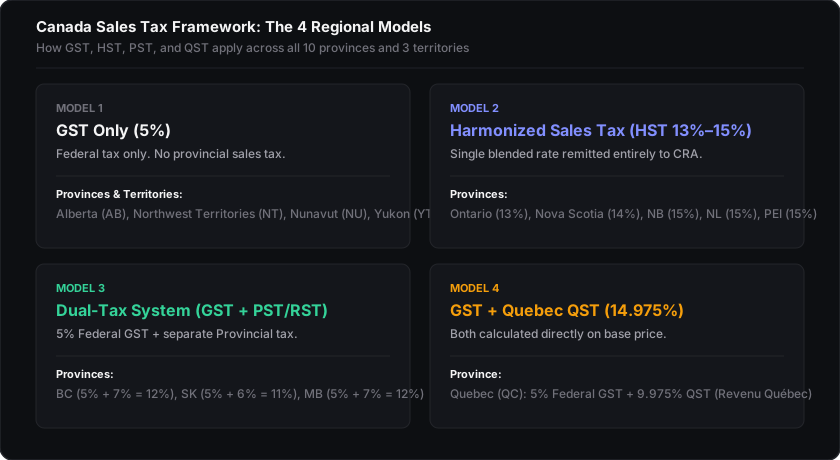
| Province / Territory | Code | Tax Regime | Federal GST | Provincial Rate | Combined Rate |
|---|---|---|---|---|---|
| Alberta | AB | GST Only | 5% | 0% | 5% |
| Northwest Territories | NT | GST Only | 5% | 0% | 5% |
| Nunavut | NU | GST Only | 5% | 0% | 5% |
| Yukon | YT | GST Only | 5% | 0% | 5% |
| Saskatchewan | SK | GST + PST | 5% | 6% PST | 11% |
| British Columbia | BC | GST + PST | 5% | 7% PST | 12% |
| Manitoba | MB | GST + RST | 5% | 7% RST | 12% |
| Ontario | ON | HST | 5% | 8% Prov. | 13% |
| Nova Scotia | NS | HST | 5% | 9% Prov. | 14% |
| Quebec | QC | GST + QST | 5% | 9.975% QST | 14.975% |
| New Brunswick | NB | HST | 5% | 10% Prov. | 15% |
| Newfoundland and Labrador | NL | HST | 5% | 10% Prov. | 15% |
| Prince Edward Island | PE | HST | 5% | 10% Prov. | 15% |
Difference Between Inclusive and Exclusive Prices & Formulas
In Canadian commerce, quotes and prices are communicated as either GST-exclusive (net amount before tax) or GST-inclusive (gross amount with embedded tax). For mathematical derivations and Excel shortcuts, read our Canadian reverse formula guide.
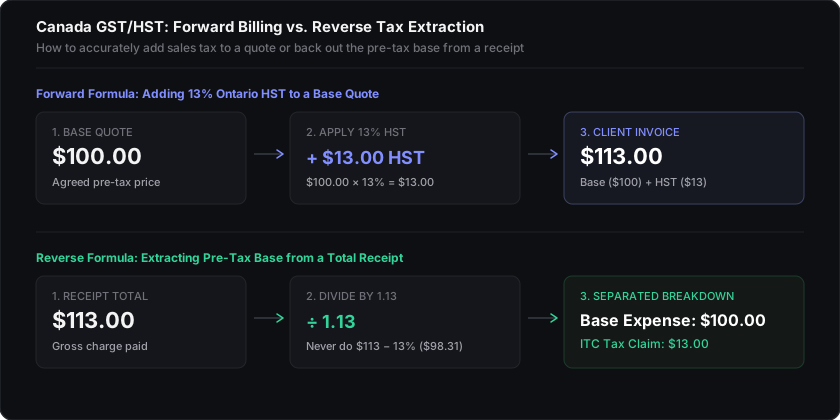
1. The Forward Formula (Adding Sales Tax to Base)
COMMERCIAL INVOICESApplied when preparing commercial quotes. Sales tax is appended directly to the taxable value:
2. The Reverse Formula (Extracting Base from Gross Total)
RECEIPTS & EXPENSESApplied when reconciling retail receipts or expense vouchers that only display the final gross total:
Invoicing Examples & CRA Input Tax Credit (ITC) Rules
For registered Canadian businesses, sales tax paid on business purchases is fully recoverable through Input Tax Credits (ITCs) claimed on Line 108 of your GST/HST return (form GST34-2). Typical transaction sizes in Ontario (13% HST):
| Transaction Value | Mode | Base Price | Federal GST (5%) | Provincial HST (8%) | Total Payable |
|---|---|---|---|---|---|
| $100.00 | Exclusive | $100.00 | $5.00 | $8.00 | $113.00 |
| $1,000.00 | Exclusive | $1,000.00 | $50.00 | $80.00 | $1,130.00 |
| $5,000.00 | Exclusive | $5,000.00 | $250.00 | $400.00 | $5,650.00 |
| $113.00 | Inclusive | $100.00 | $5.00 | $8.00 | $113.00 |
The $30,000 CRA Small Supplier Rule
Under Section 148 of the Excise Tax Act, businesses and freelance sole proprietors whose total taxable revenues do not exceed $30,000 CAD over a single calendar quarter or four consecutive quarters qualify as "small suppliers." Small suppliers are exempt from mandatory CRA registration, though voluntary registration is permitted if you wish to claim ITCs on commercial equipment.
Supplying Services or Exporting Goods to India?
Calculate statutory Indian GST with real-time 50:50 CGST/SGST intra-state splits and 100% IGST inter-state invoicing.